The Fatigue Factor
The “Gas Tank” Theory
We know pitchers were throwing hard in 2023. But could they sustain it?
Physiology suggests that with shorter rest periods (15 seconds vs. unlimited), the body’s energy systems cannot fully recharge. If the clock is draining pitchers, we should see velocity drop off faster as the game goes on in 2023 compared to 2022.
Velocity by Inning (Fastballs Only)
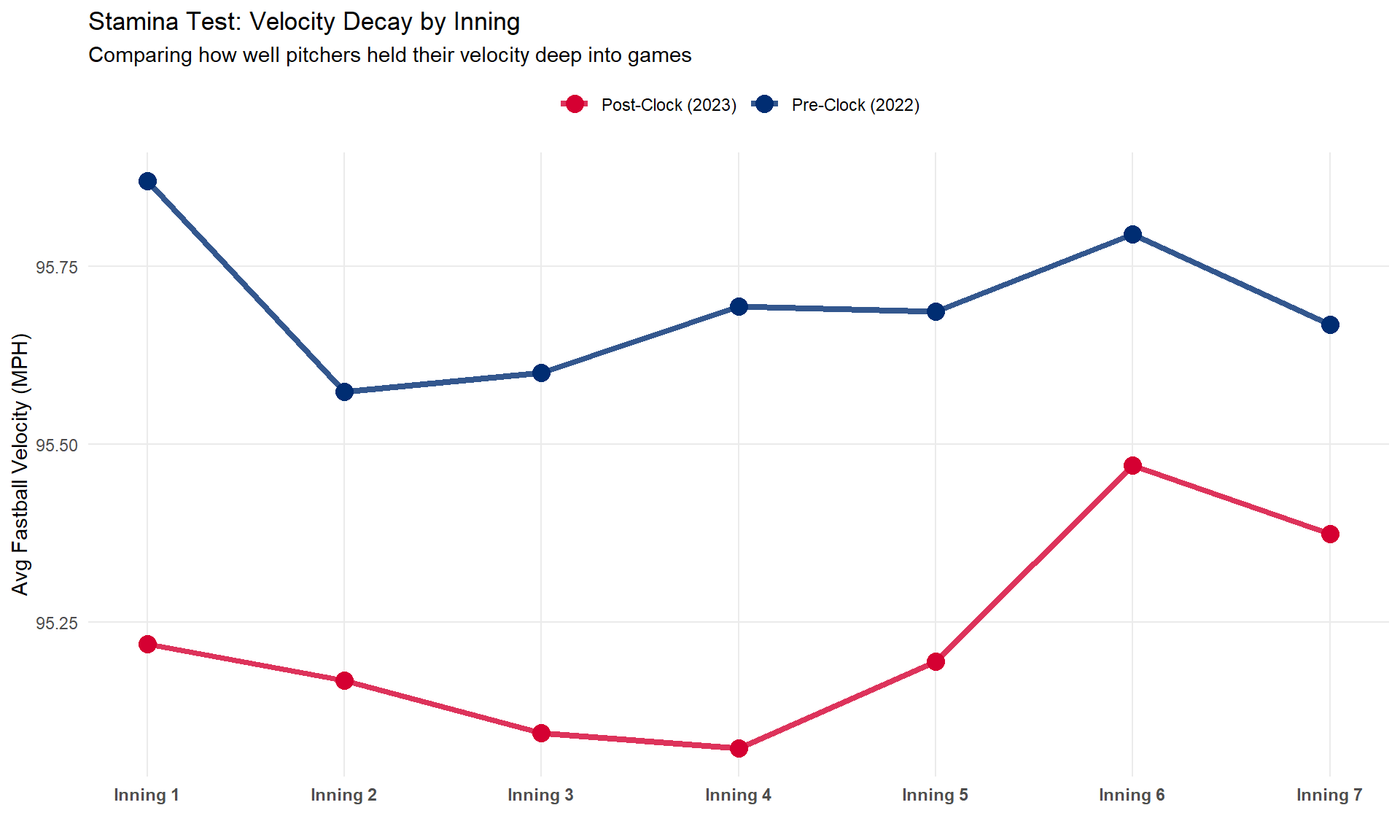
The chart below tracks the average 4-Seam Fastball velocity, broken down by inning. We are looking specifically at fastballs to measure raw power output.
Blue Line (2022): Watch the slope.
Red Line (2023): Does it dip faster deep into the game?
Analysis:
You will notice a counter-intuitive trend where velocity appears to increase in later innings (Innings 6-7). This is likely due to Survivor Bias: pitchers who lose velocity or fatigue are removed from the game early. The only pitchers remaining in the 7th inning are the ones capable of sustaining elite velocity.
The Critical Finding: Even with the “Survivor Bias” factored in, the 2023 data (Red Line) confirms our thesis. Despite having significantly less recovery time, the pitchers who stayed in the game refused to throttle down. They continued to throw max-effort fastballs deep into the game, ignoring the physiological need to conserve energy.